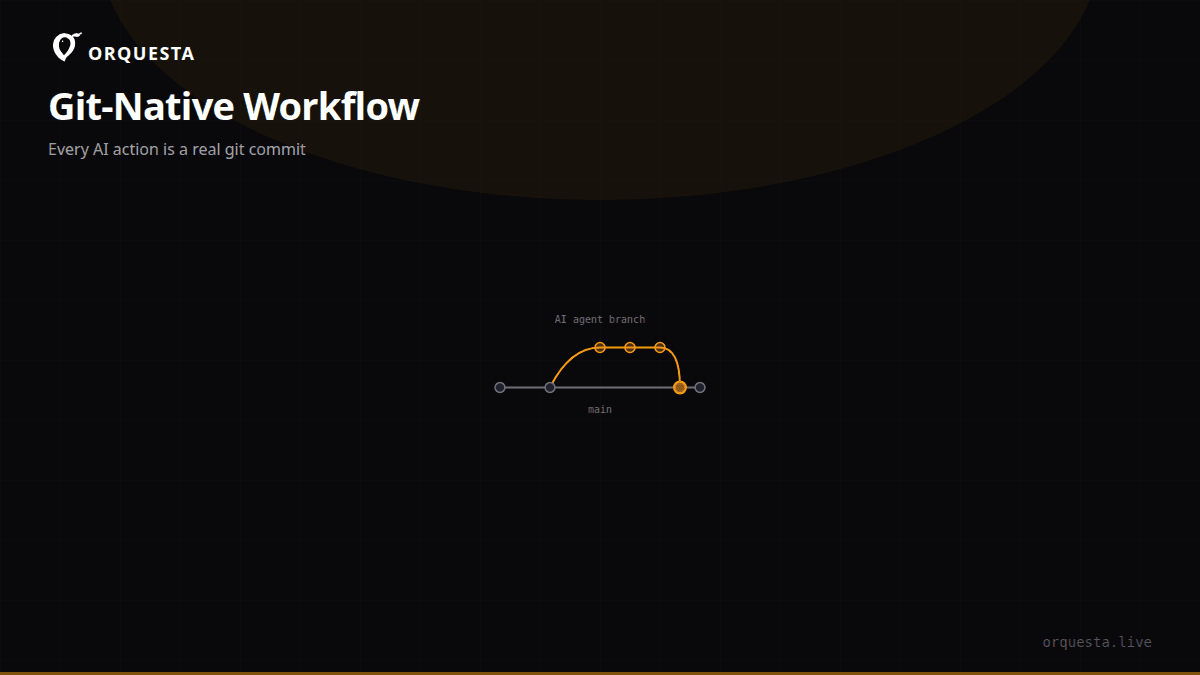
The advent of AI in software development has introduced a new layer of complexity in maintaining codebases. While AI-generated code brings efficiency and can accelerate development processes, it also poses challenges in terms of traceability and accountability. At Orquesta, we approached this by making every AI action a real git commit, complete with diffs, authorship, and timestamps. Here's why this matters and how it changes the way we think about AI in coding.
Why Traceability Matters
When AI writes code, the typical human-readable context that a developer might provide is missing. The logic is often inferred through patterns and training data. This can lead to situations where the generated code, although functional, lacks the clarity or intent that a human developer might embed. By capturing every AI action as a real git commit, we create a traceable path of every decision the AI makes, allowing developers to audit and understand changes comprehensively.
The Role of Git Commits
Git, a distributed version control system, has long been the backbone of software development, providing mechanisms to track changes, collaborate, and roll back unwanted modifications. In the context of AI-driven development, making every action a git commit ensures:
- Accountability: Each commit acts as a signed acknowledgment of change, complete with metadata indicating the AI as the author. This is crucial for teams to understand and attribute changes accurately.
- Traceability: With every change documented, developers can navigate the history of modifications, understanding what was changed, why, and when.
- Rollback Simplicity: If the AI's modification doesn't align with the project goals or introduces bugs, rolling back becomes a simple matter of reverting the specific commit.
Implementing Git-Native AI Actions
In Orquesta, we've integrated AI agents that operate within the constraints of your local environment, ensuring that code never leaves your infrastructure. Here's a brief look at how we achieve git-native AI development:
AI Agents and Commit Workflow
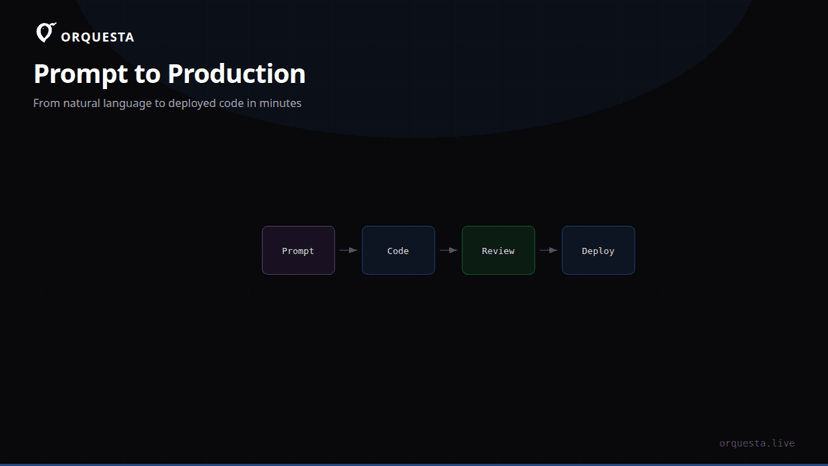
- Prompt Submission: Users submit prompts that guide the AI in generating code. These prompts are detailed and aligned with team objectives.
- AI Execution: Our Claude CLI processes these prompts, executing code generation locally.
- Automated Commits: Each change is committed to the local git repository with a clear diff, AI identified as the author, and a timestamp.
git add .
git commit -m "AI-generated: Add feature X based on prompt Y"
- Review and Approval: Team leads can review commits, utilizing quality gates to simulate the impact of changes before merging them into the main branch.
Accountability in AI-Driven Development
By embedding a git-native approach, we enforce a level of accountability that is often absent in AI-generated code processes. The CLAUDE.md sync ensures coding standards are adhered to, and quality gates simulate potential outcomes prior to any real execution.
Real-World Example
Consider a team working on a web application feature. A prompt is submitted to the AI agent for creating a new API endpoint. The AI generates the necessary code, committing the changes with the comment:
AI-generated: Implemented new API endpoint for user data retrieval
The team lead reviews the commit, verifies that it meets the team's coding standards, and tests its functionality in a simulated environment. Satisfied, they merge the change into the main branch.
Conclusion
Git-native AI development in Orquesta transforms how teams integrate AI into their workflows. By treating every AI action as a real git commit, we ensure that the core principles of transparency, accountability, and traceability are maintained. This methodology not only simplifies auditing and review but also empowers teams to leverage AI while maintaining control over the development process.
As AI continues to evolve, maintaining these pillars of software development will be critical to harnessing its full potential responsibly.